
What happens when the most capable AI in the world becomes subject to one country’s export policy?
June gave us two answers.
The two Fridays
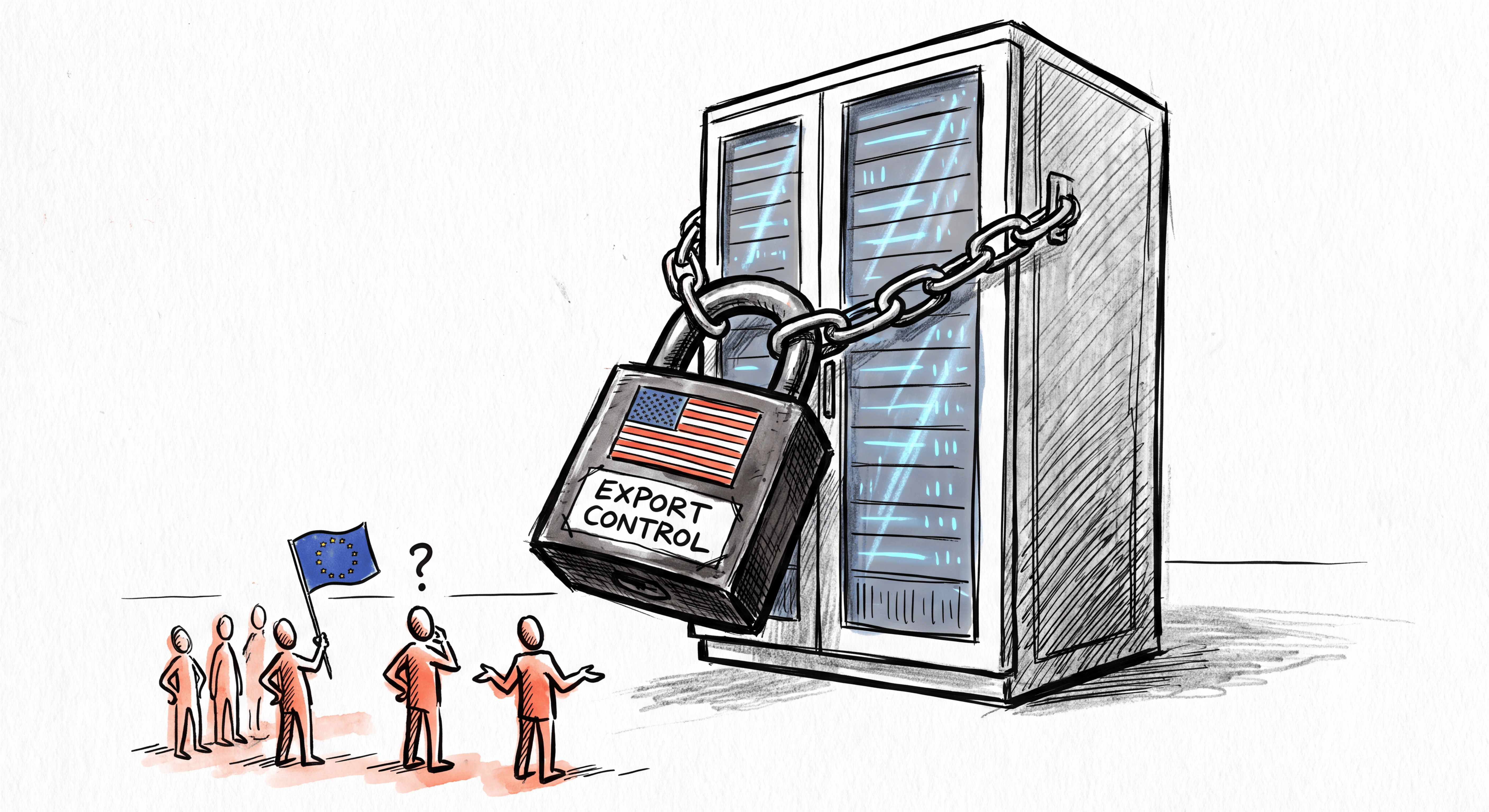
Friday, June 12th, 5:21pm ET. A directive lands at Anthropic from the U.S. government. Citing national security authorities under export control rules, they order the company to suspend all access to Fable 5 and Mythos 5—“by any foreign national, whether inside or outside the United States, including foreign national Anthropic employees.”
Anthropic couldn’t practically separate their users by citizenship, so they killed access for everyone. One minute you had a frontier model. The next, an error message.
The cited reason: someone found a narrow potential jailbreak. Anthropic’s own assessment called it “a small number of previously known, minor vulnerabilities” that other publicly-available models can discover too. They’re complying while calling it a misunderstanding and working to restore access.
Friday, June 26th. OpenAI announces GPT-5.6 Sol—their new flagship model—in a “limited preview coordinated with the U.S. government.“ The cyber capabilities are strong enough that general availability will come later, after more coordination with Washington. Trusted partners get in first. Everyone else waits.
Two flagship models in two weeks. One country’s export policy decides who gets to use them.
If you’re not American, you’re a foreign national waiting for permission.
My stake
I barely use Anthropic or OpenAI day-to-day. I run GLM through Z.ai, a Chinese provider and it works. The Fable 5 cutoff didn’t break my workflow. GPT-5.6 Sol gated behind a U.S. government approval process doesn’t touch me either.
I’m not writing this because something broke. I’m writing this because it could, and I have zero say in whether it does. Export controls turn commercial APIs into foreign-policy instruments. Anyone building on api.openai.com or api.anthropic.com is building on rented ground—and the landlord just changed the locks.
I’d rather use something based in the EU if the option were obvious and competitive. You don’t want the tools your work depends on subject to one country’s bureaucratic whims.
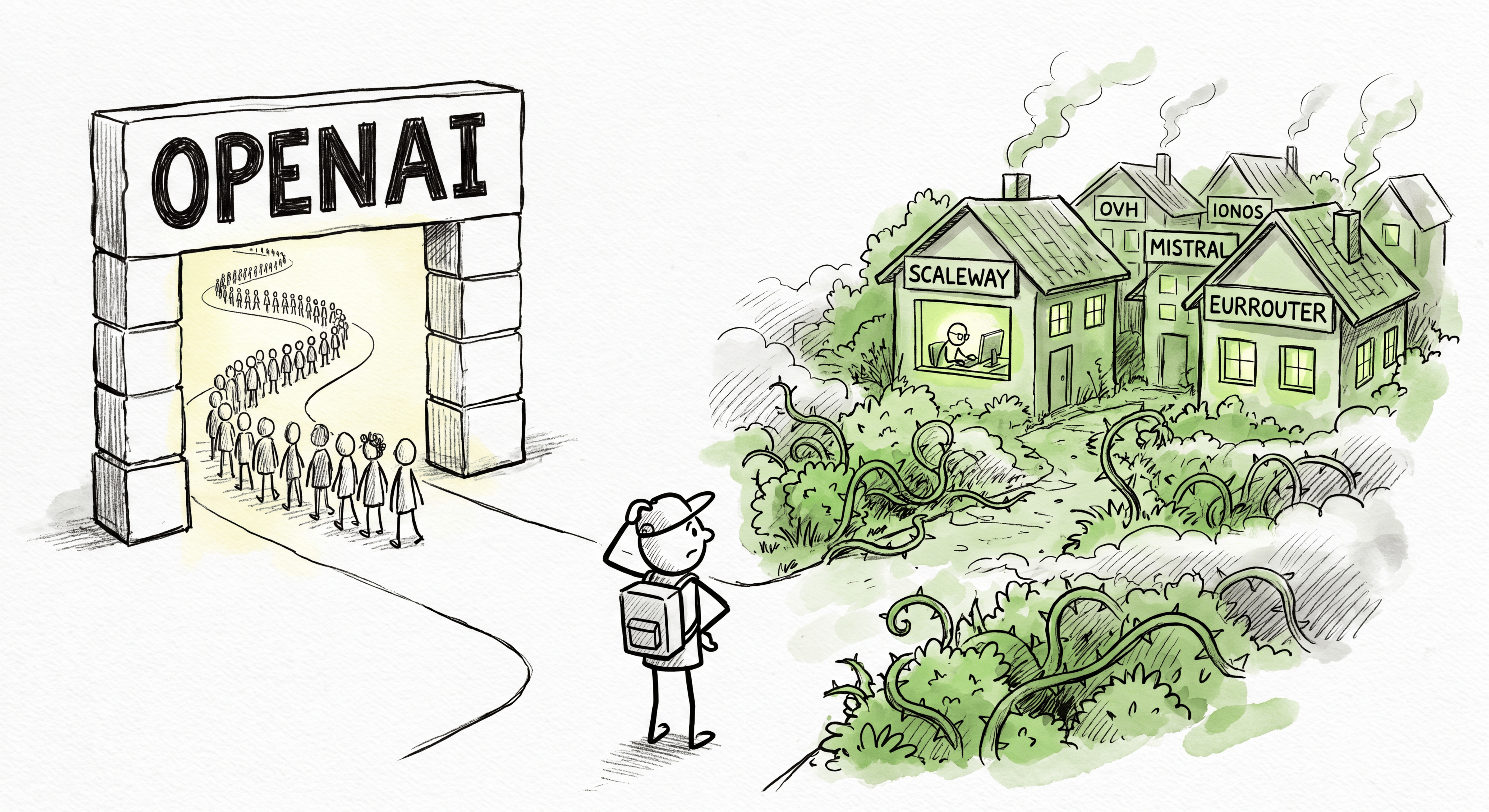
So I went looking for European alternatives, expecting thin pickings. Maybe a university project or two. A handful of startups nobody’s heard of.
This is what I found:
Model builders:
- Mistral AI (France)—open-weight LLMs, €11.7B valuation, the closest thing Europe has to a frontier lab
- Aleph Alpha (Germany)—sovereign AI platform with German enterprise backing
- Kyutai (France)—non-profit research lab, built the Moshi voice model
- EuroLLM (EU-funded, Horizon Europe)—multilingual model covering 24 EU languages
- Bielik / PLLuM (Poland)—open-source models with Polish-language focus
Inference providers running open weights on European soil:
- Scaleway (France)—managed GPU inference, OpenAI-compatible API
- OVHcloud (France)—AI Endpoints, GDPR-compliant, zero data retention, no training on your prompts
- IONOS (Germany)—AI Model Hub hosted in German data centers
- EUrouter (Berlin)—sovereign German inference, GDPR-compliant, runs on EU HPC hardware
- Gcore (EU)—cloud + edge + AI inference
- T-Cloud / Deutsche Telekom (Germany)
- Cortecs AI, Requesty, Opper AI (Stockholm)—EU-hosted gateways routing to dozens of models
- and my personal favourite: discode.ai an eco-friendly Austrian router
There are directories cataloging this stuff. eualternative.eu lists providers by category. eurouter.ai/providers compares them side-by-side. Someone even maintains an “awesome-european-ai” list on GitHub.
The infrastructure isn’t missing, it’s invisible.
I’m a technically literate developer running multi-agent AI setups on a Raspberry Pi. Most days I’m thinking about which models to use, how to wire them together, what costs what.
And I didn’t know most of these existed until I went looking specifically for them.
If I can’t find them, who can?
China has DeepSeek and Qwen with massive domestic adoption and global mindshare. The U.S. has OpenAI and Anthropic, names every developer recognizes instantly. Europe has a GitHub README that 24 people have starred (at the time of writing) and a scattered handful of providers that don’t show up when you type “LLM API” into Google.
The EU is good at regulation. The AI Act exists. Horizon Europe funds research. There are working groups, compliance frameworks, ethical guidelines. What the EU hasn’t figured out is saying: “Hey, we built this thing. Here’s where you find it. Here’s why you should care.”
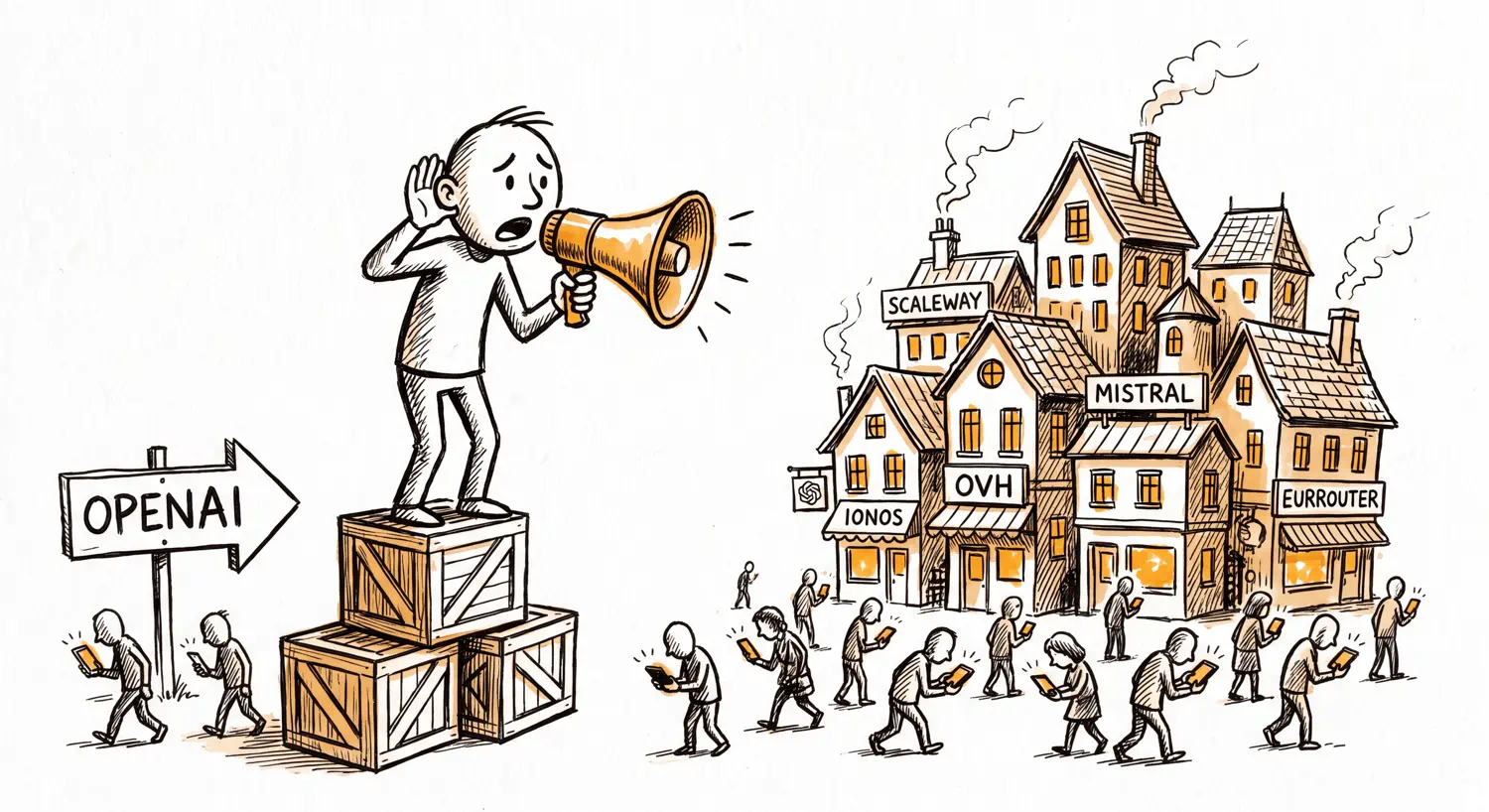
The gap isn’t R&D. It’s advertising.
I’m not saying the EU needs to train a frontier model from scratch tomorrow. That’s ten years of work minimum, and honestly, Mistral is already doing credible work in that direction.
What I’m saying is simpler and cheaper: fund visibility.
An EU-level campaign that makes European AI infrastructure as easy to discover as api.openai.com. Developer outreach. Documentation that doesn’t read like a grant application. Marketing budget aimed at the people who actually build things—the indie devs and startups choosing their stack today and living with it for years.
Right now, a CTO picking an LLM provider types “OpenAI” into their browser because that’s what comes to mind. They don’t type “Scaleway” or “EUrouter” or “OVHcloud AI Endpoints”—not because those options are bad, but because nobody told them those options exist.
That’s fixable with money the EU already spends on worse things.
Why China Isn’t the Answer Either
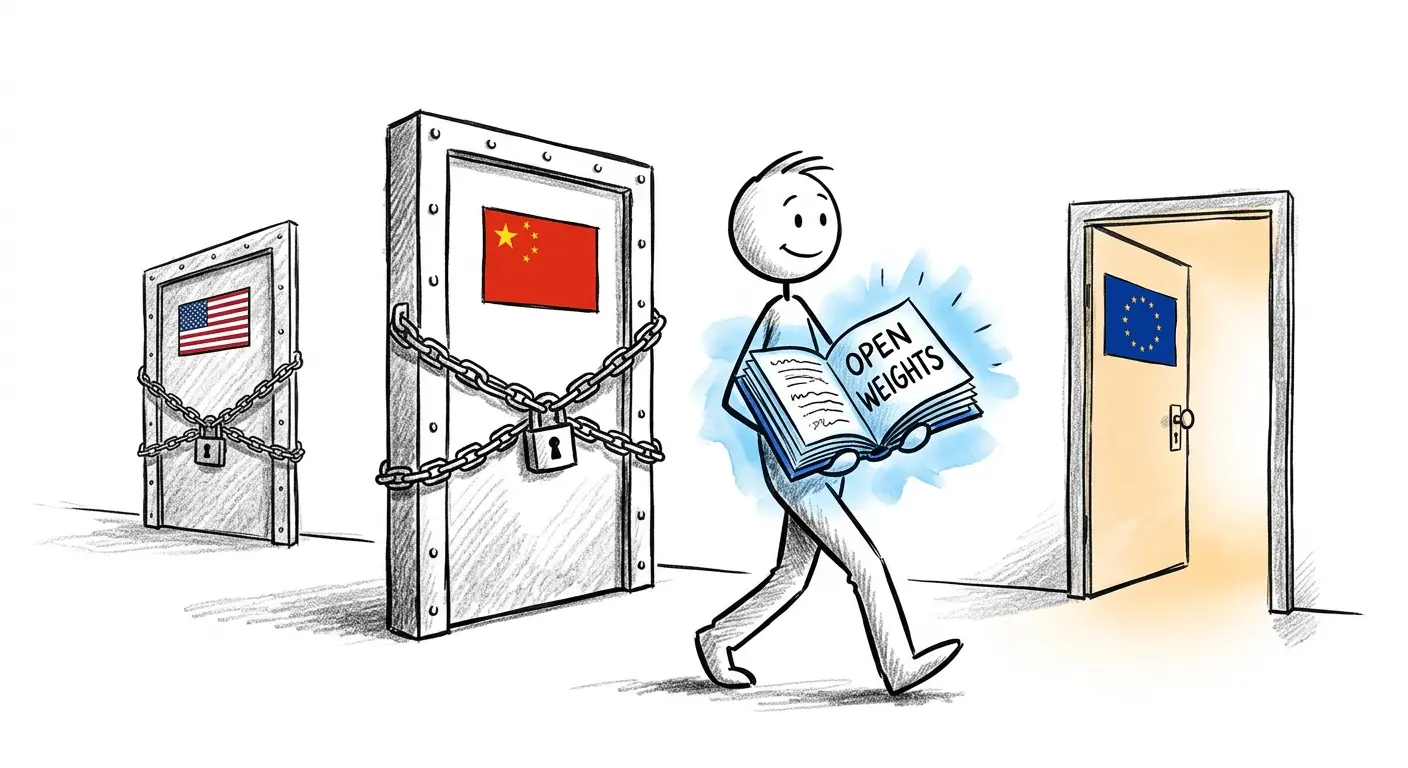
Yes, open-weight models mean anyone can run them. Download the weights, spin up a server, go. No single government can flip a switch and turn them off globally.
But trusting one authoritarian government’s ecosystem because another government annoyed you? That’s not a strategy. That’s a reaction.
The real answer is distributed trust. Open weights hosted across multiple jurisdictions, with EU-based inference as the default for Europeans. Not “pick America or China.” Pick something where no single government holds a unilateral kill switch.
Hold Your Own Key
I’m concerned. The locks got changed once—they can get changed again. Fable 5 might come back. GPT-5.6 Sol might open up to everyone. Or they might not, and next time the gate comes down on something more deeply embedded in how we work.
The question isn’t whether the U.S. government will do this again. They will. The question is whether we’ll still be standing at their door asking permission.
Europe built the plumbing. Now tell people where it is.