
I have built five dashboards for my AI agents since January. Five. All of them started the same way: a fresh project folder, a Next.js scaffold, the feeling that this time I’d build the interface that finally made sense of everything happening inside these models. None of them finished, or mattered. They’re all in a folder somewhere called things like mission-control-v3 and agent-dashboard-final and dashboard-this-time-i-mean-it.
I finally figured out why they all died. It wasn’t the code. It was that every dashboard I built put another layer between me and the thing I was trying to steer.
The mittens problem
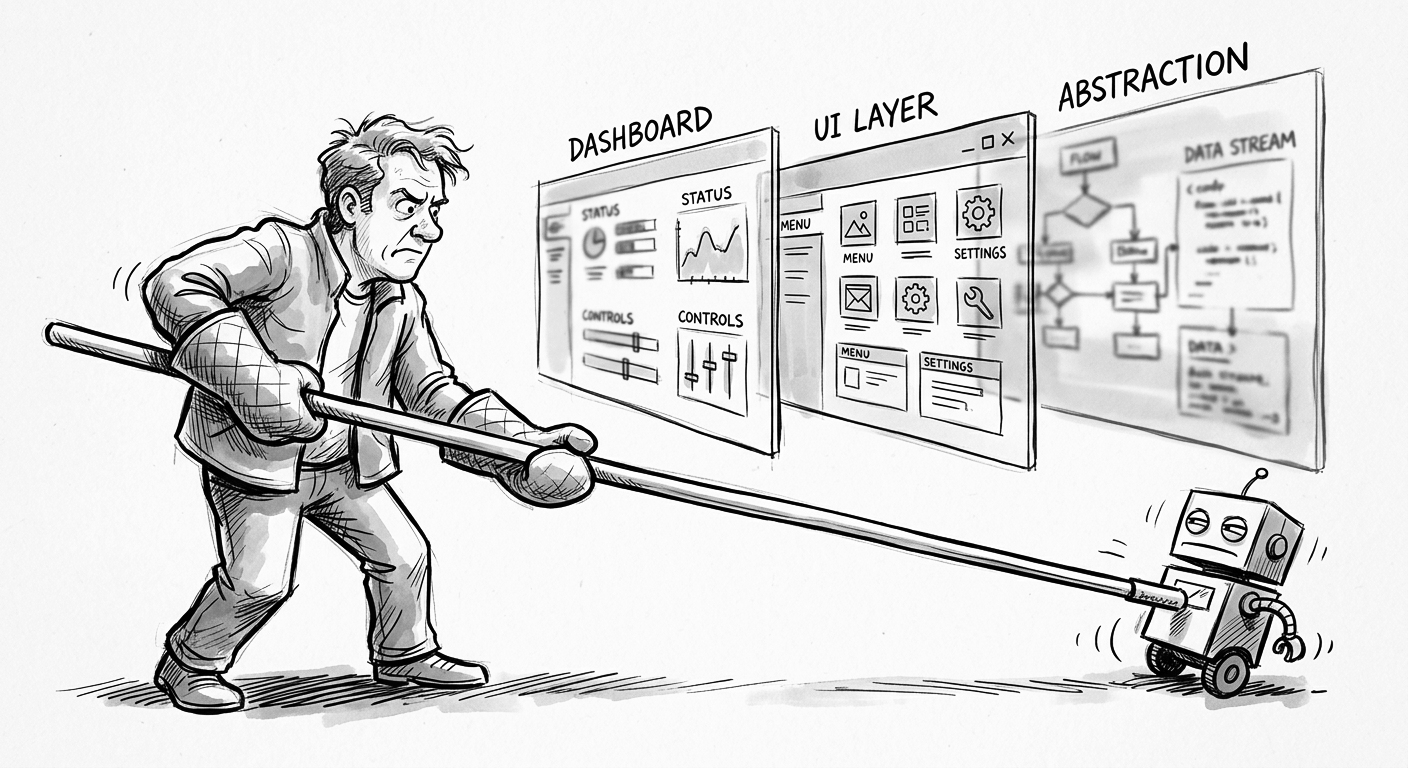
Here’s what using an AI dashboard feels like: imagine trying to guide someone who’s wearing oven mittens. And you’re holding a ten-foot pole. And the person can’t actually feel what they’re touching, so they’re just sort of waving their mitten-hands in the direction you’re pointing and hoping something works.
That’s a dashboard. That’s every dashboard I’ve tried.
The agent does something. The dashboard summarizes it. The summary collapses detail. I read the summary, form an opinion, give feedback. The dashboard translates my feedback back into whatever format the agent expects. Something gets lost at each step. Always. Not sometimes—always.
The more polished the dashboard, the worse this gets. Pretty cards with status indicators. Progress bars. Color-coded badges. All of it is compression. All of it throws away the information I actually need to make good decisions about where to steer next.
I stopped building dashboards when I realized the layer I was adding wasn’t helping me see better. It was helping me see less.
What I actually use
My setup isn’t fancy. For general AI work—the kind I’m doing right now, writing this—I use Hermes Agent through Discord. That’s it. A chat window. I pick it because Discord works from anywhere: my phone, my iPad, the laptop next to me on the couch. It’s not about the platform being special. It’s about the platform being present and then getting out of the way.
When I’m doing real coding work, I sit in a terminal. cmux, mostly, or Supacode if I’m running Pi Coding Agent directly. The terminal shows me everything. Every tool call. Every thinking block. Every file the agent touched and why. Nothing is collapsed into a card. Nothing is summarized into a badge color. If the agent spent three minutes reasoning through a problem before writing twelve lines of code, I can watch it happen. I can interrupt it if it’s going sideways. I can say “stop, try this instead” before it wastes twenty more tokens heading down a dead end.
That’s direct. That’s me working with the agent, not managing it through an interpreter.
Enter the orb
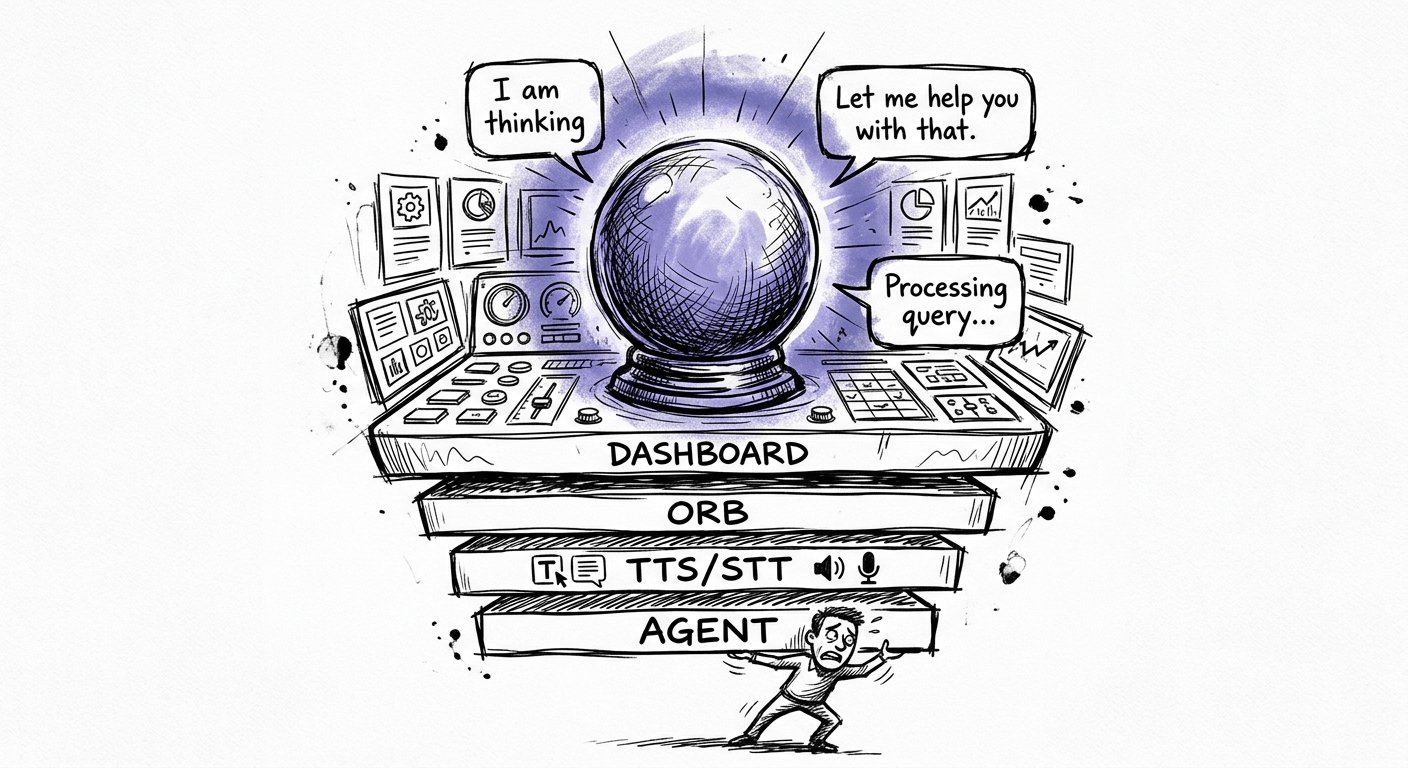
So here we are in mid-2026, and the YouTube crowd has found a new way to sell the same dashboard idea they’ve been pushing since OpenClaw launched. They’ve rebranded it.
Now it’s called “Agent OS.” Or “Claude OS.” Or whatever OS sounds sufficiently futuristic for the thumbnail. The concept is identical: put a GUI in front of your AI agent. But the big new feature, the thing they lead every demo with, is a glowing orb in the middle of the screen. And the orb talks. Text-to-speech pipeline, speech-to-text input, the whole thing. You speak to the orb. The orb speaks back. It glows while it thinks.
I watched Chase AI do this first. Two videos—a whole series about building an “Agent OS” with a talking orb centerpiece. Then Mark Kashef did his version. By the second one I’d had enough.
Here’s what the orb actually adds: nothing. It demos beautifully. It looks incredible in a thumbnail. But functionally it’s just another abstraction layer on top of the abstraction layers I already don’t want. You’re not closer to the agent. You’re further away. Now there’s TTS processing your input before the model sees it, and STT processing the output before you hear it, and a glowing sphere animating in the middle like some kind of AI crystal ball, and none of it helps you understand what the agent is actually doing or thinking.
It’s a dashboard wearing a costume.
Why this keeps happening
I think the reason people keep building these things—and the reason I kept trying to build them myself—is that a terminal feels wrong. It feels unfinished. It feels like you should have something prettier around this technology that’s supposed to be changing everything. A glowing orb feels like progress. A command line feels like you forgot to build the UI.
But the command line isn’t missing a UI. The command line is the UI. It’s just one that shows you everything instead of deciding what you’re allowed to see.
Every layer between you and the agent is a decision someone else made about what information matters. The dashboard developer chose which status codes to surface. The orb designer chose how to represent “thinking” as a glow effect. The TTS pipeline chose which words to emphasize with intonation. Those choices might be fine for a demo. They’re terrible for actual work, because actual work lives in the details that get smoothed away.
I want the raw feed. The unfiltered stream. The messy, verbose, sometimes-boring reality of what the agent is actually doing. Because that’s where understanding lives. That’s where I learn whether the agent is on track or spinning its wheels or about to do something I didn’t ask for.
You can’t steer what you can’t see. And no amount of glowing spheres changes that.